Selecting Belt Cleaners by Material Type
After a conveyor belt passes the discharge point, some material may remain attached to the belt and travel into the return run, creating a common problem known as material carryback. Although the residue may appear similar on the belt surface, its formation and adhesion characteristics can vary significantly. Wet and sticky materials tend to form thick, continuous layers; fine powders may be compacted into thin, dense films; and highly abrasive particles can continuously wear down the blades, causing cleaning performance to decline over time.
Therefore, belt cleaner selection should not be based solely on belt width, equipment model, or blade hardness. Material properties—including moisture content, stickiness, particle size, hardness, and abrasiveness—directly influence blade material, contact angle, tensioning method, the number of cleaning stages, and the required discharge space. Without first understanding these characteristics, even a properly installed belt cleaner may fail to remove carryback effectively, cause secondary material buildup, experience rapid blade wear, or even damage the belt surface.
The Core Pain Point:Treating All Material Carryback as the Same Problem
One of the most common mistakes when addressing material carryback is to attribute the problem directly to “insufficient cleaner pressure” or “a blade that is not hard enough.”
In reality, carryback is not caused by a single factor. It results from the combined effects of material characteristics, belt surface conditions, discharge conditions, and cleaner configuration. Materials with high moisture content and stickiness may remain on the belt because of their strong adhesion. Fine powders may be compressed between the belt and pulley into a thin, dense layer. Hard particles may continuously wear down the blade, gradually creating gaps between the blade and the belt.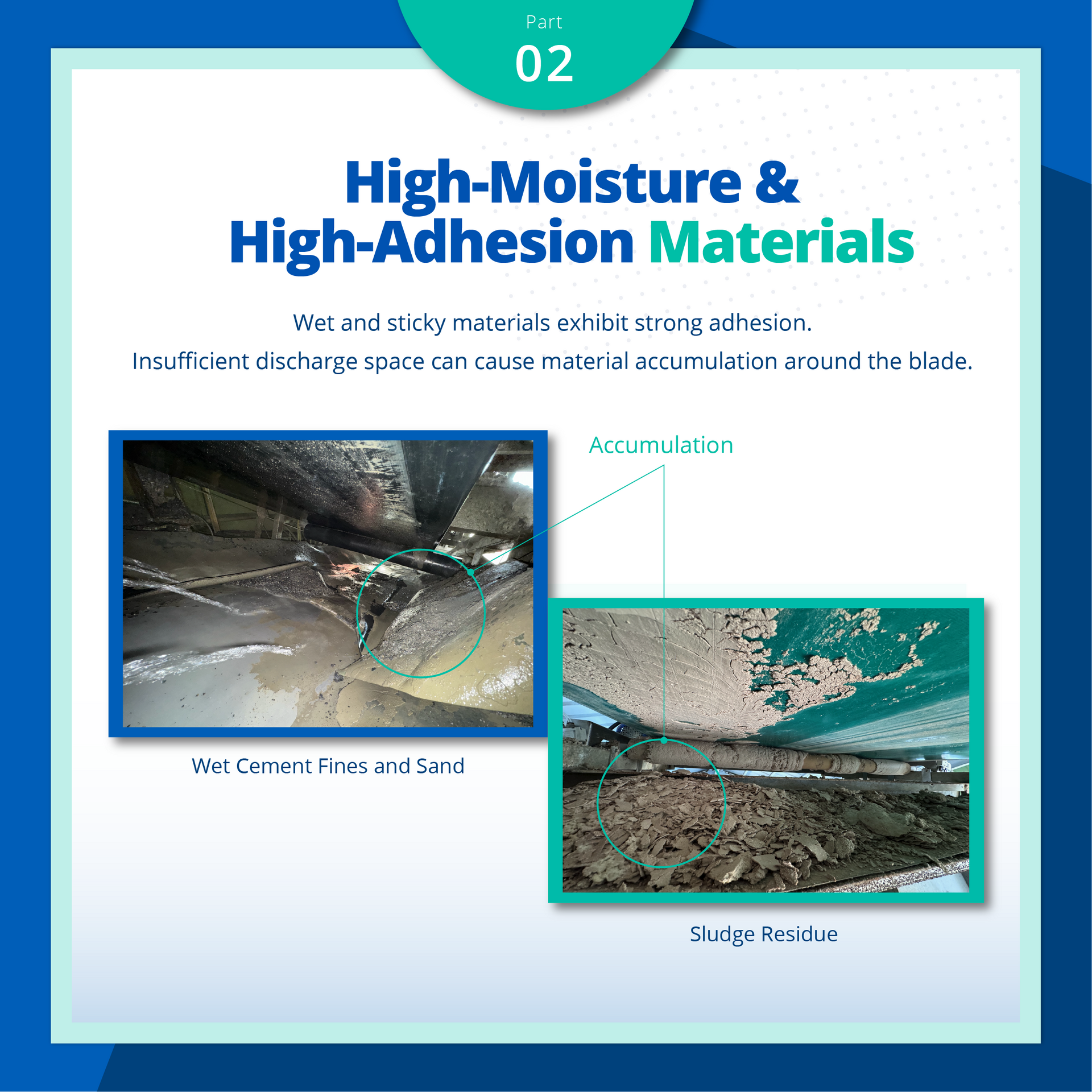
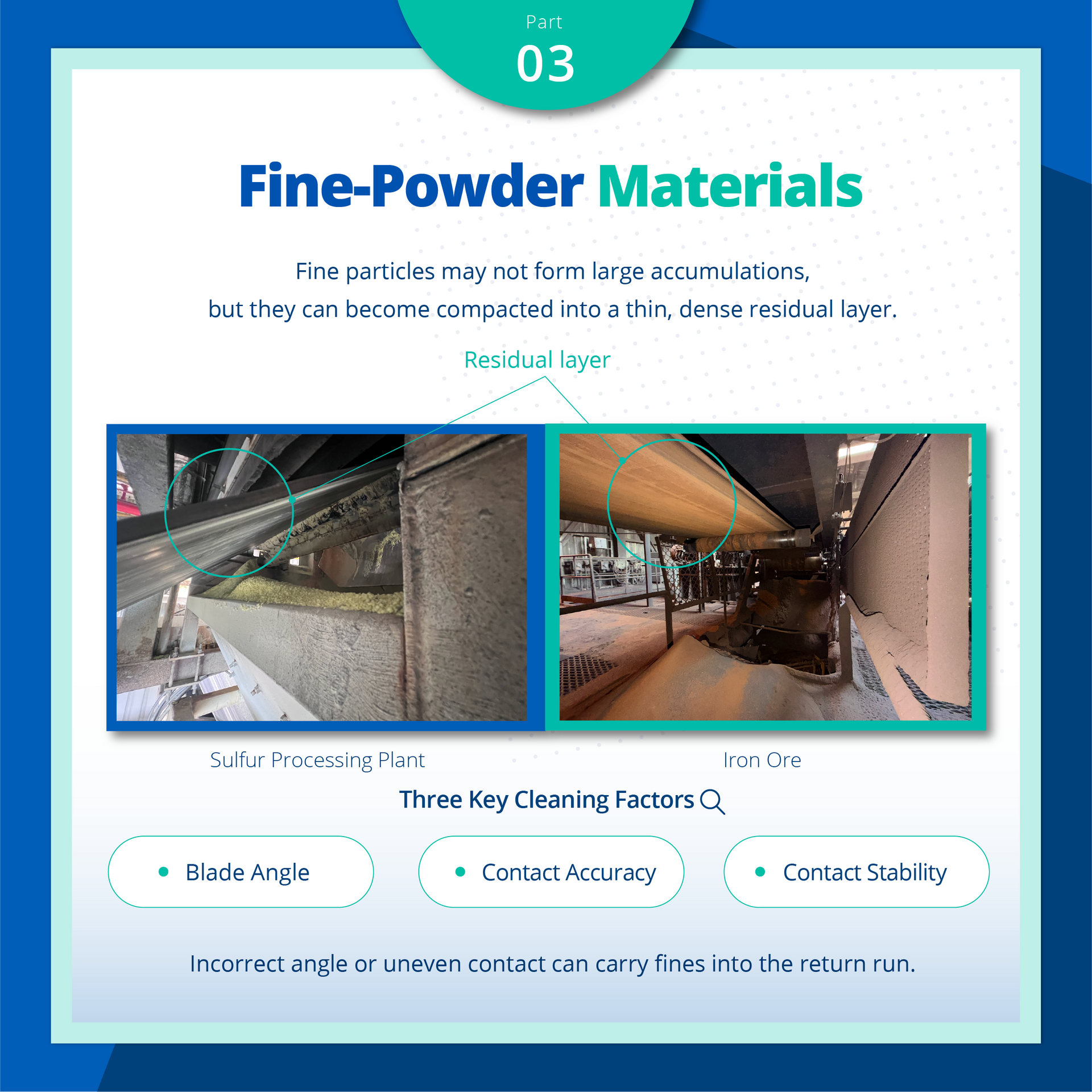
Even when the blade is in contact with the belt, this does not necessarily mean that stable cleaning performance can be maintained. An incorrect installation angle, uneven tension distribution, or localized blade wear may prevent the blade from maintaining continuous contact with the belt surface, allowing wet, sticky material or fine powder to pass through the gaps.
Cleaning performance also depends on more than whether the material can be separated from the belt surface. The removed material must also be able to discharge smoothly. This is particularly important for wet and sticky materials. If they accumulate beneath the cleaner, behind the blade, or around the blade holder, they may obstruct blade movement and alter the original contact angle and tensioning condition, resulting in continuous secondary buildup.
The key conclusion is that belt cleaner performance cannot be evaluated solely by contact pressure or blade hardness. The formation of the carryback, blade angle, contact stability, tensioning condition, and discharge space must all be examined to identify the actual factors affecting cleaning performance.
The Solution:Establish a Complete Selection Logic Based on Site Conditions
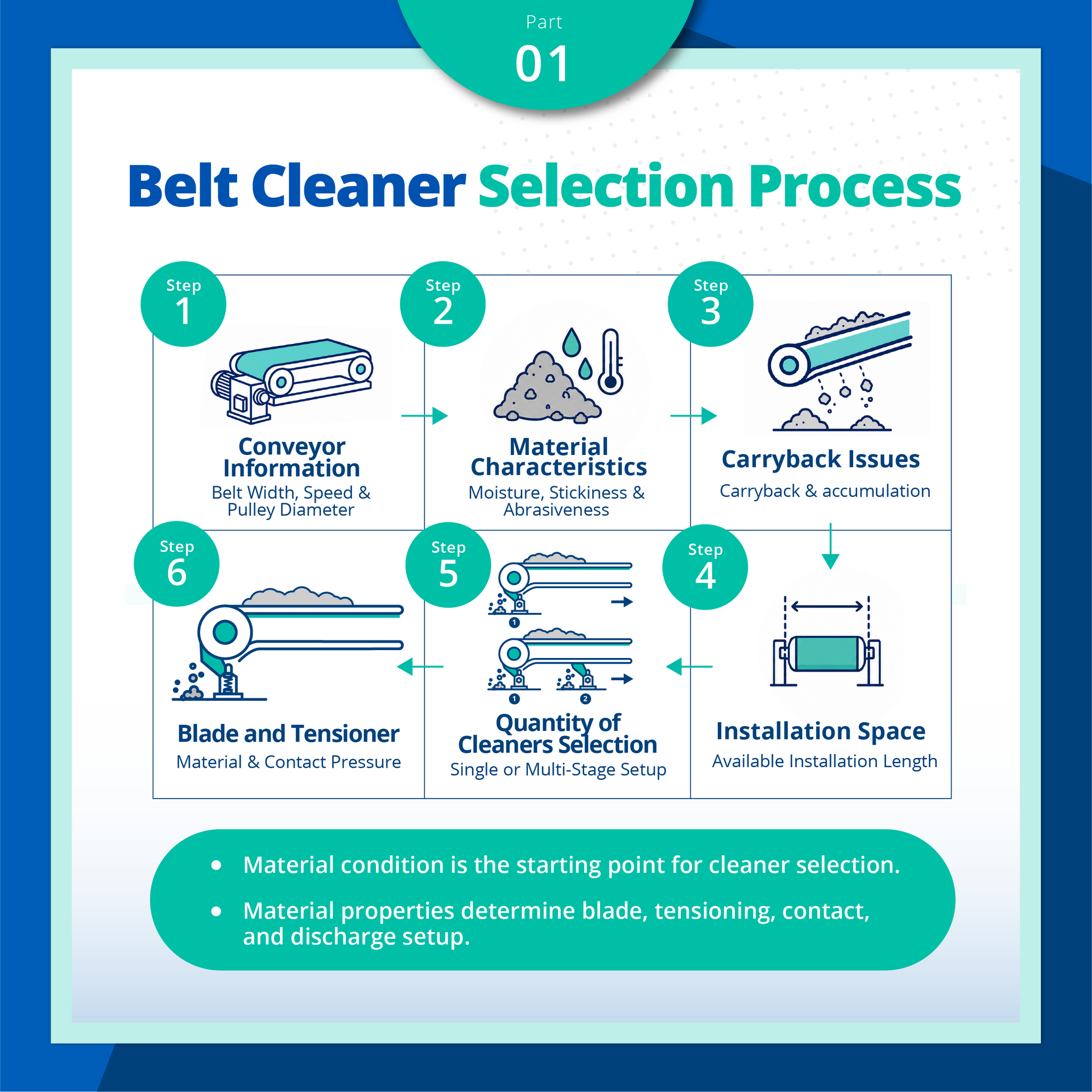
Belt cleaner selection should be carried out step by step according to actual operating conditions.
The first step is to confirm the conveyor’s belt width, belt speed, and pulley diameter. These parameters determine the appropriate cleaner size, installation position, and available mounting space. The next step is to evaluate the material’s moisture content, stickiness, and abrasiveness, while observing whether the carryback forms a thick adhesive layer, a thin powder film, or causes rapid blade wear.
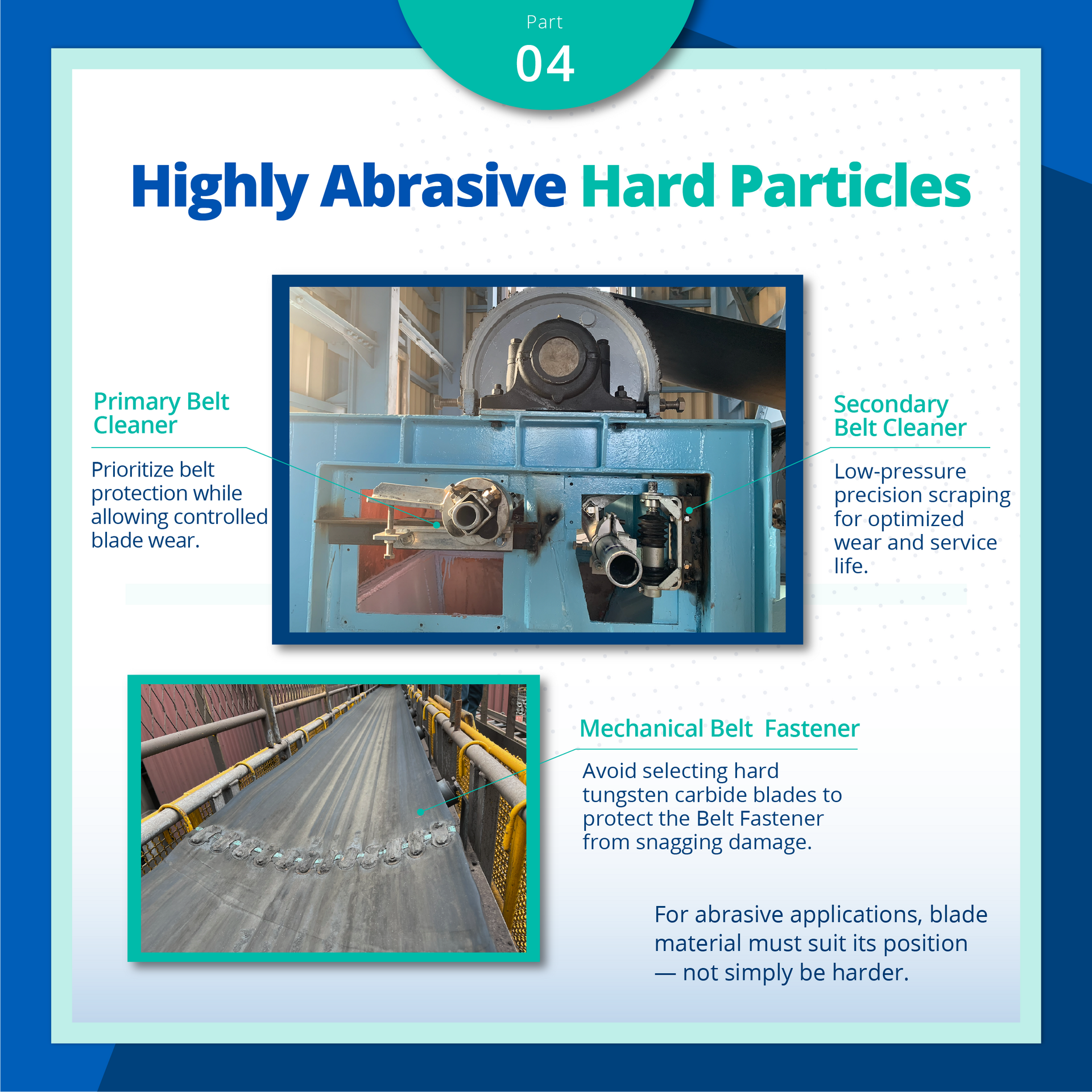
After identifying the material characteristics and carryback pattern, the available space around the cleaner must also be assessed to ensure sufficient room for installation, material discharge, and maintenance. If a single cleaner can remove the main buildup but cannot eliminate the fine residual film on the belt surface, a multi-stage arrangement using both primary and secondary cleaners should be considered, rather than continuously increasing the contact pressure of a single blade.
The blade material and tensioning method should then be selected according to the cleaner position, belt surface condition, and whether the belt uses mechanical splices. The tension should be sufficient to maintain stable blade-to-belt contact, but higher pressure is not always better. Excessive pressure may accelerate blade wear and increase the risk of damage to the belt surface.
After installation, performance should not be evaluated only by whether material is removed during the initial operation. The residual pattern on the belt surface, the discharge of removed material, and the blade’s ability to maintain stable contact as it wears should all be monitored. This is necessary to confirm whether the selected cleaner and configuration are truly suitable for the operating conditions.
Wet and sticky materials, fine powders, and highly abrasive hard particles each place different demands on belt cleaners.
Wet and sticky materials require both effective removal and sufficient discharge space.
Fine powders require precise blade angles, accurate contact, and stable blade-to-belt conformity.
Highly abrasive materials require a balance between cleaning performance, blade service life, and belt protection.
Belt cleaner selection should therefore not rely solely on hardware specifications, nor should a single blade or cleaner model be assumed to suit every operating condition. Only by starting with the actual material characteristics and considering the conveyor conditions, carryback pattern, installation space, and number of cleaning stages can a stable and reliable belt cleaning solution be established.